Power
power
Energy & Electricity
energy-electricity
5 min. read


Key takeaways
Annual global investment in data centers reached $771 billion in 2025, nearly on par with oil and gas ($835 billion) and renewable energy ($798 billion). AI has reshaped the energy landscape, and CERAWeek reflected it.
The demand challenge is accelerating. US peak electricity demand is forecast to grow 224 GW over the next decade, driven by data centers. The rise of agentic AI is pushing compute demand up by an estimated 10–20x, overwhelming chip efficiency gains and accelerating electricity demand beyond what forecasters projected even a year ago. The grid cannot keep pace.
Carbon removal was largely absent from the CERAWeek agenda, but the need is growing. Companies are locking in decades of emissions despite net-zero commitments, while carbon removal investment lags.
Uncertainty dominated at CERAWeek, but so did possibility. AI-driven electricity demand, grid constraints, carbon accounting, and carbon removal are connected. The companies that navigate these challenges with technical depth and a grounding in policy and finance will likely have an advantage.
CERAWeek has a new center of gravity
CERAWeek by S&P Global has always served as a proxy for where the energy industry thinks the world is going. This year's theme, "Convergence and Competition: Energy, Technology and Geopolitics," addressed the tension directly. Despite the scale and energy of the gathering, the overall tone was more muted than in prior years. Uncertainty was the watchword, and the acknowledgment of seismic shifts in energy systems, from geopolitics, macroeconomics, and AI, created a sense of unease in some and opportunity in others.
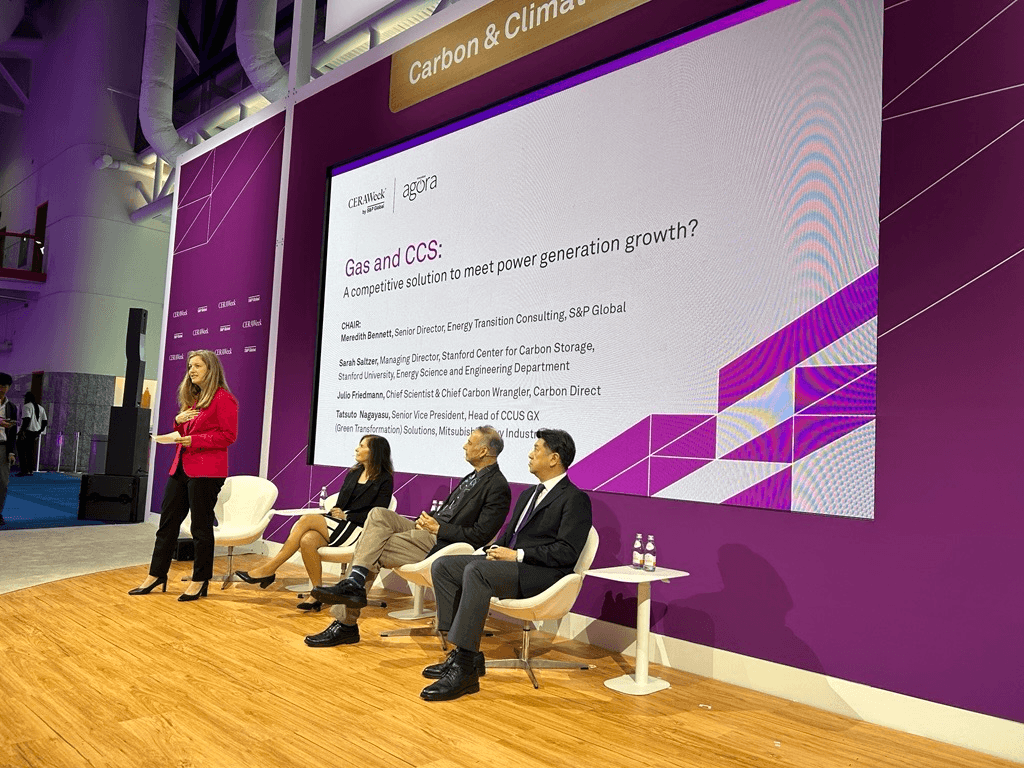
Carbon Direct Chief Scientist Julio Friedmann, PhD, presented twice at this year's conference, first on industrial electrification on Monday and then on natural gas with carbon capture and storage (CCS) on Wednesday.
The conference had a clear center of gravity: AI, grid constraints, and the surging demand from hyperscalers. The intersection of these forces fundamentally reshapes the energy landscape in ways that are both exciting and sobering. This year, AI companies anchored CERAWeek prominently alongside traditional energy players. Nvidia, Anthropic, and CyrusOne joined the established tech presences of Microsoft, Google, and AWS, occupying the Innovation Agora's new AI Hub, which displaced the hydrogen hub from prior years. That chip makers and digital infrastructure companies headlined the same stage as Federal Energy Regulatory Commission (FERC) commissioners and oil majors reflects how rapidly and profoundly the energy landscape has shifted.
The capital flows underscore it. Annual global data center investment hit $771 billion in 2025, up from approximately $30 billion a decade ago, nearly matching oil and gas ($835 billion) and renewable energy ($798 billion) in a single year. The speed at which this reordering appeared, and the prominence of power generation as the enabling constraint, was not lost on attendees from either side of the event.
Uncertainty dominated the conversation
What distinguished CERAWeek 2026 from prior years was not what was discussed but how. Tech companies arrived announcing gigawatt-scale power commitments. The energy industry’s response was less triumphant than hesitant: the grid, the supply chain, and the permitting system cannot currently move at the required speed. Transmission takes more than a decade to build. New generation commonly takes five to nine years. AI infrastructure moves on three-to five-year timelines. The prevailing tone was uncertain: the gap between what is being announced and what can actually be delivered was the subtext of almost every conversation at the conference.
Panels dedicated significant time to questions without settled answers: How long will AI load growth continue at this pace? How will AI be used to improve hydrocarbon recovery, and how will it also support climate benefits and new energy opportunities? At what point do chip efficiency gains outpace growth in compute demand? And most critically, how can we meet and manage the demands for speed, speed, speed?
While energy efficiency in chips is advancing roughly 1.4x annually, the rise of agentic AI is driving compute demand up by an estimated 10–20x, overwhelming those gains. As a result, major hyperscalers are now looking seriously at fundamentally different approaches to ultra-high-efficiency computing, such as photonic (light-based) chips. Few could address questions of AI's impact, from workforce to finance to grid management. These conversations will be unavoidable at the next CERAWeek.
The geopolitical backdrop amplified this unease. Conflict in the Gulf region weighed heavily on the week. Many attendees and presenters from the Middle East remained home. Whatever the present geopolitics, no attendee had predicted them last year. Discussion of liquefied natural gas (LNG) exports, supply chain resilience, and force majeure exposure shared a common thread: non-linearity, where individual decisions carry disproportionate global consequences. The gestalt of CERAWeek was not triumphant but measured. Most attendees brought more questions than answers.
The electricity demand challenge
Summer peak demand across the US bulk power system is forecast to grow by 224 GW over the next 10 years, more than double the prior year's projection, with data centers as the dominant driver. Texas alone is projecting over 40 GW of data center load by 2028, against a total peak demand today of approximately 85 GW. New capacity will not be a sufficient near-term solution. The build timelines simply don’t match, creating chokepoints and price spikes.
Load flexibility is the fastest path to closing that gap. Original power system modeling by Carbon Direct of the Electric Reliability Council of Texas (ERCOT) grid found that data center demand response can prevent $5.5 billion in annual consumer welfare losses by curtailing an average of five percent of demand for under one percent of operating hours. What the industry has discussed in qualitative terms now has a dollar figure.
The FERC final rule on large electrical load interconnections, expected by April 30, 2026, clears procedural hurdles. It does not build new grid capacity. The underlying supply-demand mismatch remains the primary gating factor.
Clean, firm power: What’s moving, what isn’t
CERAWeek 2026 covered significant ground beyond oil and gas. Electricity displaced molecules as the focal point of the energy transition conversation, and the attendance reflected it. The Clean Energy Buyers Alliance, investor-owned utilities like Constellation, merchant generators like Calpine, and FERC commissioners were as prominent on the agenda as the majors.
The clean, firm power conversation was substantive. Geothermal drew the most consistent endorsement of the week, with Department of Energy (DOE) representatives, oil and gas majors, and operators broadly aligned on its potential—a new form of drill, baby, drill. Enhanced geothermal systems (EGS) received the most attention, with Meta’s 150 MW power purchase agreement with Sage signaling that hyperscalers have moved EGS into active procurement. Natural gas with CCS, complemented by long-duration energy storage, drew similar interest as the fastest near-term bridge to clean, firm power.
What the conference left genuinely open was the question of standards. The Greenhouse Gas (GHG) Protocol's scope 2 guidance revision, with final standards expected in 2027, will determine how 24/7 matching, deliverability, and additionality are treated across procurement strategies worth hundreds of billions of dollars. Companies signing power purchase agreements (PPAs) and forward renewable energy certificate (REC) contracts today are doing so under conditions of methodological uncertainty. Scenario modeling is a prerequisite.
The carbon removal gap
Carbon removal was largely absent from CERAWeek’s agenda. Panels were lightly attended, and several carbon removal companies de-emphasized removal in their messaging. Buyers lack contracting clarity beyond 2030.
Carbon removal needs to grow at 30% annually through 2050 to meet long-term climate targets. It is currently growing at two percent. The capital commitments announced this week will generate emissions for decades. The market being built to address them is not keeping pace.
Opportunity will favor the prepared
While the sense of uncertainty at CERAWeek was real, so was the sense of possibility. The Innovation Agora brought forward many new companies with solutions ranging from new generation technologies to new industrial processes to IT solutions to drones.
The through-line at CERAWeek 2026 was clear: AI is driving power demand faster than the grid can respond. Clean, firm power options are advancing, but each faces real constraints on speed and scale. Carbon accounting standards remain in flux. Companies are locking in decades of emissions despite making net-zero commitments. The carbon removal capacity needed to close that gap is lagging.
These are facets of the same problem: how do you scale AI infrastructure responsibly when the energy system, the carbon markets, and the accounting rules are all in motion at the same time?
The companies best positioned don’t necessarily win on capital or speed alone. They win by navigating uncertainty with rigor: quantifying the value of load flexibility, stress-testing procurement strategies across accounting scenarios, and integrating power, infrastructure, and carbon strategy before the standards that govern all three are finalized.
New partnerships and investments will follow CERAWeek 2026. We look forward to exploring and shaping them with our clients.
How Carbon Direct can help
Carbon Direct works with hyperscalers and large energy buyers on the full spectrum of power and decarbonization decisions: from grid access and load flexibility to clean, firm power evaluation, carbon accounting, and carbon removal.
Get in touch to explore how Carbon Direct can support your power and decarbonization strategy.