New Carbon Direct power system modeling puts a dollar figure on what flexible load is worth.
Power
power
Energy & Electricity
energy-electricity
Climate Policy
climate-policy
9 min. read




Key takeaways
The electricity demand surge is real and accelerating. Data center load in the US is projected to increase from 25 GW to 120 GW by 2030, with Texas alone projecting over 40 GW of data center load by 2028, nearly half of today’s total peak demand of approximately 85 GW.
Flexible loads that respond dynamically to policy signals are becoming a regulatory requirement. Texas Senate Bill 6 (SB6), signed into law in June 2025, is the clearest signal yet. It requires new large loads above 75 MW connecting to ERCOT to demonstrate load flexibility by curtailing power on demand during declared emergencies.
Carbon Direct’s power system modeling puts a dollar value on what data center load flexibility is worth. Our ERCOT analysis shows that data center demand response can eliminate forced load shedding risk, even at 40 GW of data center buildout – preventing $5.5 billion in annual consumer welfare losses by curtailing an average of 5% of demand for under 1% of operating hours.
Flexible load curtailment and compute uptime do not need to be in conflict. In our modeling, demand response operates as a "ghost battery" at the data center's grid node, absorbing grid stress as a physical battery would. That construct has a direct real-world analog: on-site battery storage lets data centers draw from stored energy during grid stress events rather than curtailing workloads. Technologies, such as those demonstrated by Emerald AI, show that 25% load curtailment is achievable without GPU service interruption.
Data center electricity demand is testing grid limits
Electricity demand in the United States is growing at its fastest pace in decades. Leading the surge is a rapid buildout of data centers, driven by the expansion of artificial intelligence. ERCOT, the grid serving most of Texas, is projecting up to 40 GW of new data center load by 2028, against a total peak demand today of approximately 85 GW.
The scale of this shift extends across the country. According to NERC's 2025 Long-Term Reliability Assessment (LTRA), summer peak demand across the US bulk power system is forecast to grow by 224 GW over the next 10 years, more than double the prior year's projection, with data centers as the dominant driver. As previously explored by Carbon Direct, data center energy capacity in the US is projected to increase from 25 GW to 120 GW by 2030, characterizing it as the first wave of a longer demand surge that electrification of buildings and transport will reinforce.
Policymakers are responding in real time, and regulatory responses like Texas SB6 are already rewriting the rules for how data centers connect to the grid. The pace of change is fast, but the siting, infrastructure, and interconnection decisions made today will have lasting consequences: they will determine whether data centers are grid assets or grid liabilities, and the financial difference between the two is measured in billions.
New solutions for data center demand response: Texas SB6 as a test case
The rapid nature of this new wave of load growth means traditional approaches to managing the grid may not be sufficient. In the past, lead times on new sources of electricity demand allowed utilities to procure supply-side resources in advance. The scale and immediacy of data center deployment is revealing limitations of this approach. States, utilities, independent system operators (ISOs), and regulators are actively pursuing novel approaches for grid management in response.
Texas has become a focal point of US data center expansion, with SB6 as a leading policy response. The bill, which took immediate effect upon Governor Greg Abbott's signature on June 21, 2025, is the most significant restructuring of large-load interconnection rules in ERCOT's history. It requires large loads over 75 MW to curtail power on instruction from grid operators during declared grid emergencies. If data centers are adding substantial new load to the grid, this reasoning goes, they should also contribute to grid stability by demonstrating load flexibility—reducing power draw at times of peak demand.
While demand response programs currently exist, incentivizing voluntary curtailment from data centers is challenging. In an AI compute arms race, the value of uninterrupted compute time far exceeds any available curtailment payment, such as via PJM’s capacity market mechanisms.
Approaches to bridge that gap are coming to fruition: EPRI’s DCFlex program is working with hyperscalers and utilities to develop the technical protocols, measurement standards, and contractual frameworks that would make large-load demand response a routine grid service. Innovators like Emerald AI are demonstrating that 25% load curtailment is possible without GPU service interruption, helping to bridge the valuation asymmetry between energy and compute.
Hyperscalers are already putting a flexible load commercial strategy into action. Google this week announced 1 GW in demand response contracts with multiple US utilities, including Entergy Arkansas, Minnesota Power, and DTE Energy.
The conversation has shifted from whether data centers can be flexible to how that flexibility gets structured and deployed.
Putting a dollar value on data center load flexibility
For developers, investors, and grid operators navigating data center growth, the challenge has been making high-stakes siting and interconnection decisions without a clear picture of what load flexibility is actually worth, what inflexibility costs the system, or how curtailment requirements will reshape the regulatory landscape.
Prior research has established that flexible data center load can absorb substantial grid stress. For instance, research from Duke University’s Nicholas Institute found that the US grid could absorb up to approximately 100 GW of new flexible data center load with curtailment needed in fewer than 1% of annual hours across 22 of the largest US balancing areas.
Carbon Direct’s analysis goes further by quantifying the economic cost at each increment of flexible load growth, and the precise threshold at which that flexibility stops being optional. We zeroed in on ERCOT, a region with high data center load growth and immediate regulatory stakes, determining the value of implementing flexibility and, conversely, the system risk of failing to do so.
How we modeled it
Assessing the impacts of load growth and flexibility solutions requires a systems-level analysis, best achieved via power market modeling. At Carbon Direct, we deploy our in-house power system modeling framework to navigate this complexity.
Our toolkit includes CD-PyPSA-USA, used for this analysis, which is built on the Python for Power System Analysis (PyPSA) platform. This grid model simulates how power networks operate and evolve over time by solving for the least-cost optimization of the entire power system. Critically, our model is customized to explicitly represent complex, real-world dynamics, including data center load flexibility, co-located generation, and various policy constraints.
For this analysis, we simulated ERCOT operations under a range of data center growth scenarios. We modeled loads from 5 GW up to 40 GW in 5 GW increments, pairing each with sufficient on-site gas generation to cover roughly 70% of data center energy needs—a conservative estimate on the approach developers are taking today.
We ran each scenario under two conditions: no load flexibility (“flex00”, the baseline) and 25% emergency curtailment capability (“flex25”), consistent with solutions exhibited by Emerald AI. This approach allowed us to determine the system's response to step-changes in electricity demand.
Voluntary curtailment, forced outages, and the value of lost load
This analysis makes an important distinction between three curtailment types: one voluntary and two involuntary electricity demand reductions.
Demand response or load flexibility (voluntary reduction): This involves industrial consumers curtailing their power requirements in response to pricing or regulatory incentives. Participation is optional.
Mandatory curtailment (targeted reduction): This is a required, controlled reduction of power draw by a specific consumer group (e.g., data centers under Texas SB6) when directed by grid operators during declared emergencies. This is a deliberate policy directive aimed at grid stability.
Load shedding (forced outage): This is a non-targeted, involuntary outage event, such as a rolling blackout, where the system operator must cut power to prevent grid failure. These events affect all types of consumers, including residential and commercial electricity demand.
Grid operators in Texas use a value of lost load (VoLL) of $35,000 per megawatt-hour (MWh) to measure the welfare cost borne by businesses and households who lose power involuntarily. That figure, the standard benchmark applied by ERCOT in reliability and market design analysis, is what we use as the basis for valuing shedding events in our modeling. At $35,000 per MWh, even a small number of unplanned outage hours produces welfare losses in the billions.
What our analysis reveals
Before doing the analysis, we expected to see load flexibility become more important as more data center load is added to the grid, preventing forced load shedding with high lost-load costs. But we didn’t know how large this effect would be, or what amount of new data center load would start to trigger it.
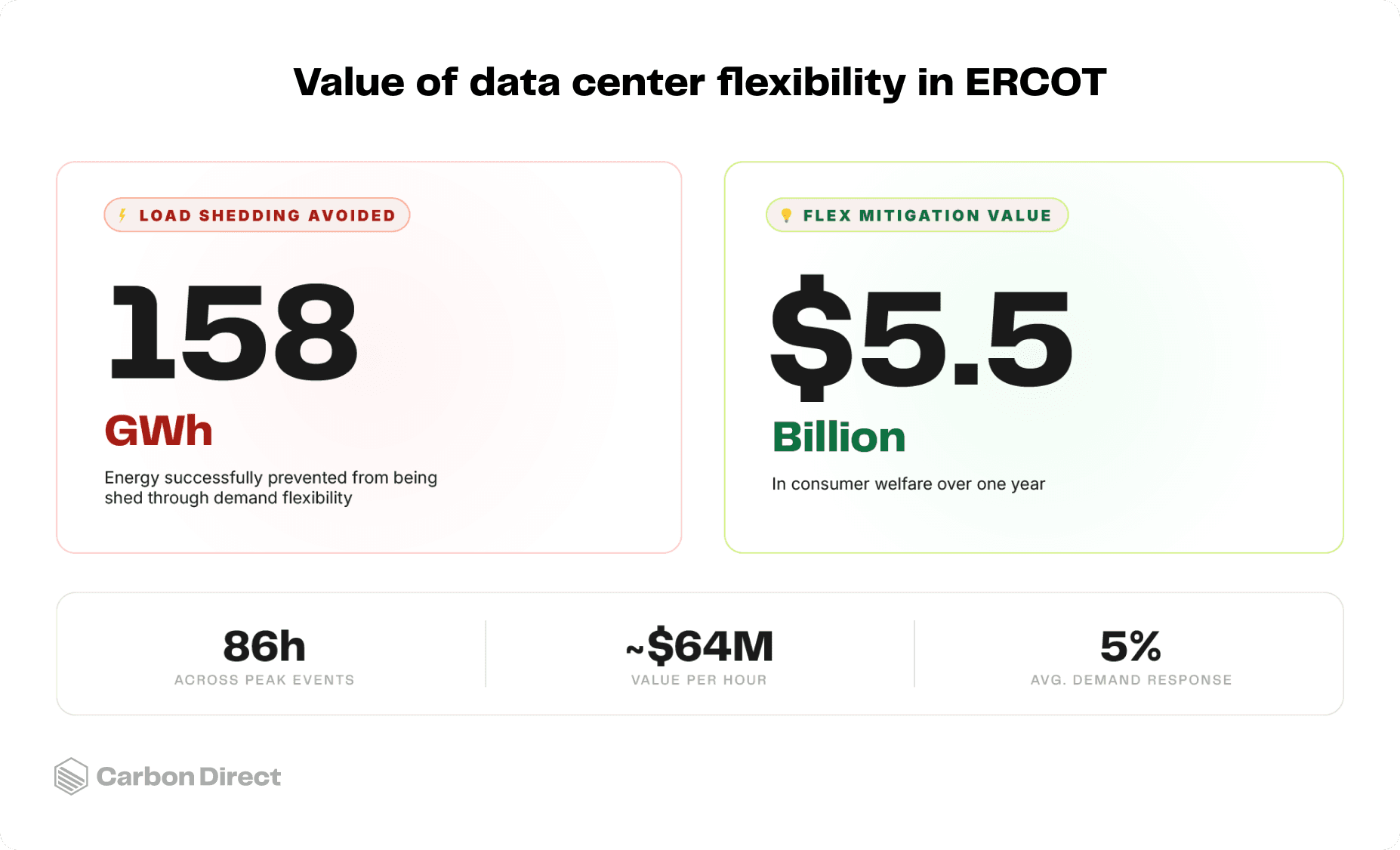
Our analysis found that without flexible load management, forced load shedding first appears at 30 GW, small in scale at first (4.4 GWh over 3 hours) but growing sharply as load increases. At 35 GW, we observe 50 GWh of shedding across 39 hours. At 40 GW, shedding reaches 158 GWh across 81 hours, equivalent to nearly three times ERCOT’s average daily energy consumption, with an economic cost at VoLL of approximately $5.5 billion.¹
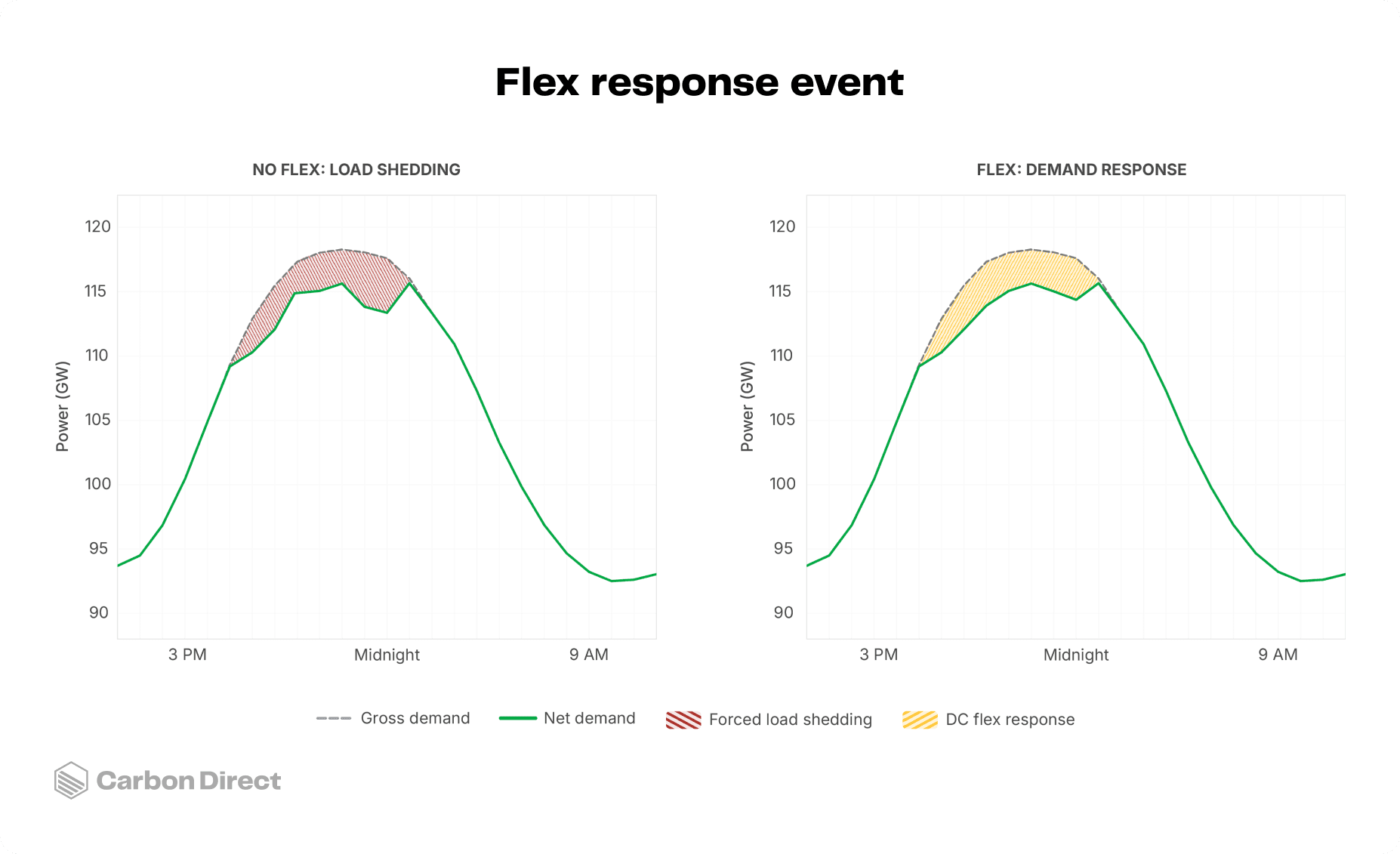
Figure 1. Hourly ERCOT load with 40 GW data center demand. Load shedding events (A) and demand response deployed to mitigate shedding events (B). Modeled using CD-PyPSA-USA.
By enabling on-demand data center load flexibility, forced load shedding is eliminated in every scenario we tested. The same 40 GW case instead sees 165 GWh of controlled, short-duration curtailment spread across 86 hours, less than 1% of hours in a year. Further, the average demand response in these hours was less than 5% of the nameplate data center load, with the largest event reaching 14% of data center load. The grid stays balanced, consumers remain connected, and data centers deliver substantial value to the system via flexible loads.
Load flexibility is high value and presents an opportunity for storage
Our modeling puts a dollar figure on what flexible load is worth. At a VoLL of $35,000/MWh, each hour of demand response in the 40 GW scenario delivers approximately $64 million in avoided consumer welfare losses. Over a full year, that adds up to $5.5 billion, achieved through an average of just 5% demand response across the 86 hours of curtailment needed to eliminate all forced load shedding.
That value points directly to an opportunity for storage. In our model, demand response functions as a “ghost battery” at the data center’s grid node, absorbing grid stress exactly as a physical battery would, without any electrons needing to flow. That virtual battery can become a real one. On-site battery storage allows a data center to dispatch stored energy during grid stress events rather than curtailing workloads, maintaining compute continuity while relieving grid pressure.
The implications point in two directions.
For the hyperscaler or data center operator, physical storage converts a compliance obligation into an uptime guarantee: the curtailment event becomes a battery discharge, with negligible impact to the compute stack.
For the storage developer, co-location with large data center loads represents a high-value deployment opportunity with a clear commercial case. The avoided welfare costs per curtailment hour our model quantifies is the value a well-positioned battery asset, co-located at a data center node, can credibly claim to preserve.
The data centers of tomorrow need to be grid assets
The data center buildout underway is large enough to reshape grid reliability across entire regions, and the regulatory environment is beginning to reflect that scale. Texas SB6 is the most prescriptive example to date: it requires new large loads above 75 MW to install remote curtailment equipment operable during firm load shed events.
Our modeling quantifies what load flexibility is worth across this landscape: data centers with curtailment capability can provide significant value and avoid billions in consumer welfare losses annually. For developers and investors, designing that capability in from the start can convert a compliance requirement into a long-term grid asset.
How Carbon Direct can help
Carbon Direct is a trusted leader in power and energy advisory. Our experts apply advanced energy modeling to answer the most challenging market and policy questions. We help hyperscalers, large commercial energy buyers, large-load developers, operators, utilities, and investors evaluate power procurement, flexible load requirements, storage integration, reliability exposure, and long-term clean power strategy using market-specific grid modeling.
If you are navigating how data center load growth affects your grid strategy, please contact us to help you evaluate your power needs.
¹ Results are sensitive to the VoLL valuation and modeling assumptions, including: the weather year and frequency/severity of peak demand events; the geographic distribution of new data center load and associated transmission constraints; the proportion of data center energy needs met by co-located generation; and the broader supply-side generation mix assumed for ERCOT.