Environmental Justice
environmental-justice
Power
power
4 min. read

Key takeaways
A review of 40 US-based climate and clean energy projects shows that community benefits are foundational, not peripheral, to project development. 
Developers increasingly blend fiscal, infrastructure, workforce, environmental, and procedural benefits, but inconsistent frameworks can lead to uneven and inequitable outcomes. 
A shared language for defining and monitoring benefits can help ensure climate and clean energy development advances climate goals while supporting frontline communities.
Community benefits shape project outcomes
As the US scales climate and clean energy infrastructure, the stakes for communities are growing. Projects like offshore wind installation, grid modernization, hydrogen hubs, and CO₂ transport pipelines reshape landscapes and can transform local economies for decades. While projects often aim to provide community benefits, these benefits are not universally defined or consistently implemented. This lack of clarity has real consequences, including delays, disputes, and uneven outcomes for the communities most affected by climate change and infrastructure siting.
Meanwhile, technology continues to deploy rapidly and federal standards on community benefits are shifting. In this landscape, developers and communities must navigate evolving expectations without a shared vocabulary. Establishing a common language for defining, implementing, and monitoring community benefits is a strategic imperative for ensuring project viability and climate equity.
Carbon Direct’s Community Impacts team recently conducted a qualitative review of community benefits documents from 40 US-based climate and clean energy projects, drawn from three major national databases. Our review integrated expert interviews with a structured qualitative analysis. This research yielded a cross-technology comparison of how projects define, deliver, and monitor community benefits.
What are community benefits?
In practice, community benefits refer to the positive outcomes that climate and clean energy projects commit to delivering to local communities, especially those that have been historically impacted by environmental burdens. While these tools have become emerging parts of project design, a lack of shared language for how these benefits are defined, implemented, and monitored means that results may vary dramatically from one project to the next.
A fragmented landscape with emerging patterns
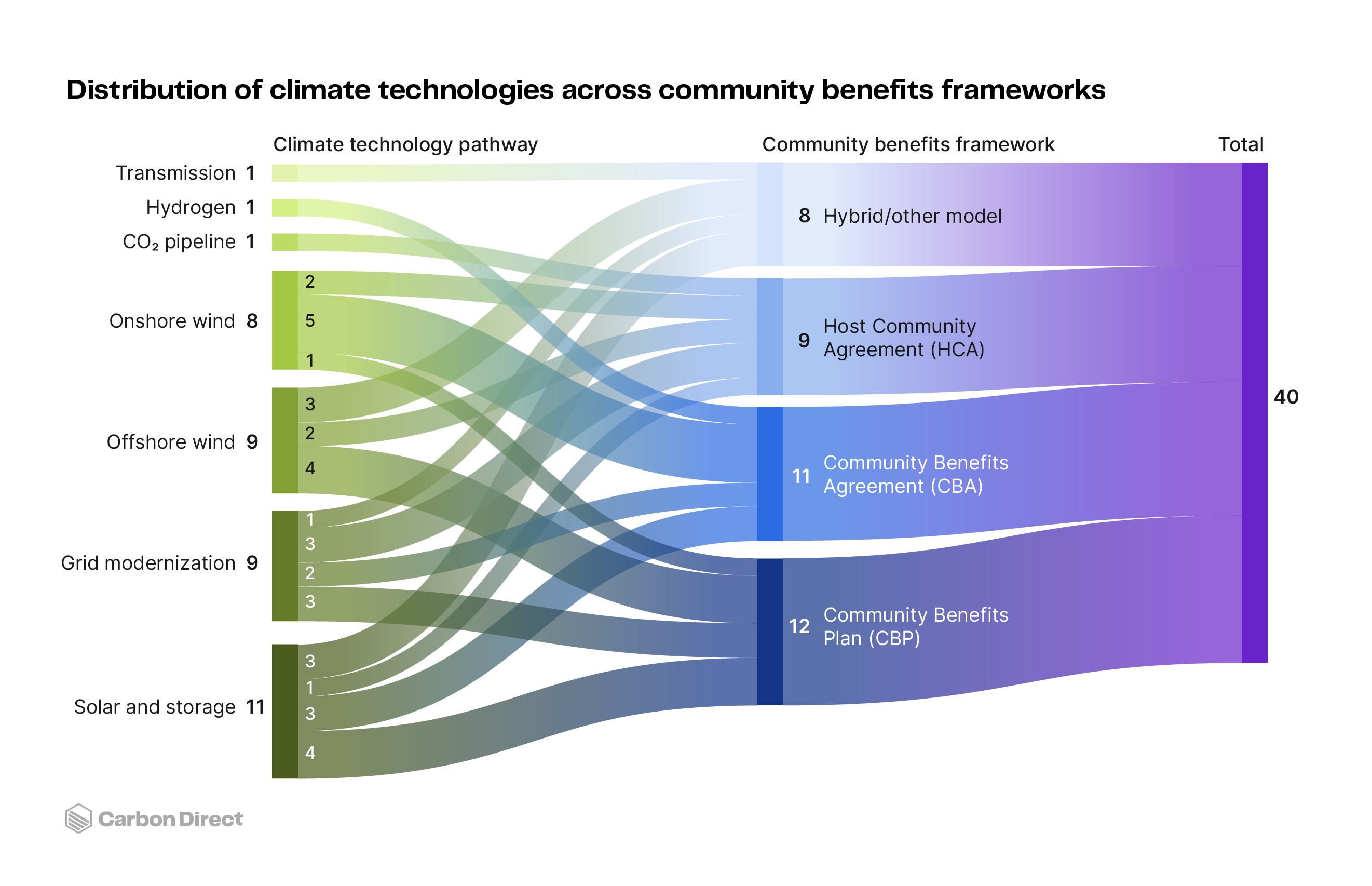
Carbon Direct analyzed community benefits documents from 40 climate and clean energy infrastructure projects across seven technology sectors: onshore and offshore wind, solar and storage, CO₂ pipelines, hydrogen and clean energy hubs, high-voltage direct transmission, and grid modernization. These projects spanned from 2017 to 2024. Our analysis drew from three major databases: Columbia Law School's Sabin Center, World Resources Institute, and a joint effort by California Forward and UC Berkeley's Possibility Lab.
While the structure and quality of community benefits differ widely across sectors and regions, we identified several patterns that formed the basis of a taxonomy for consistently describing community benefits across projects. This taxonomy is based on three emergent themes:
Benefit frameworks: We found four distinct frameworks: Community Benefits Agreements, Community Benefits Plans, Host Community Agreements, and hybrid approaches.
Benefit categories: We found five distinct categories, including fiscal (payments, tax revenue), infrastructure (physical improvements, services), workforce (jobs, training), environmental (restoration, emissions reductions), and procedural (governance participation, transparency).
Benefit approaches: We found a range of approaches based on benefits characteristics such as target (what does the benefit aim to achieve), beneficiary (who receives the benefit, e.g., individuals, municipalities, regions), benefit duration (one time, recurring, performance based), benefit directness (direct vs. indirect), benefit enforceability (contractual, programmatic, aspirational), and social equity (whether or not a benefit is targeted to historically marginalized or disadvantaged groups).
Our findings show that earlier projects often rely on transactional models such as one-time payments, fixed host fees, or road maintenance commitments. Newer approaches, especially those modeled on community benefits plan guidance from the US Department of Energy under the Biden Administration, embed measurable equity metrics, participation requirements, and ongoing reporting.
Building a shared language for a just transition
A just transition requires more than clean electrons on the grid or megatonnes of CO₂ removed. It requires that benefits flow to the communities most impacted by the overlapping impacts of historical disinvestment and climate change, and that those communities have a meaningful role in shaping the projects built around them.
Encouragingly, our review shows that projects are gaining momentum: procedural equity and community involvement are becoming more common, and developers increasingly track equity-focused metrics. However, gaps still remain that are largely driven by inconsistent language and standards around community benefits. Community benefit frameworks often prioritize institutional beneficiaries (e.g., municipal governments or large landowners), rather than residents. Procedural equity is the least standardized and least enforced benefit category. And federal rollbacks of community benefit requirements under the Trump administration risk widening these gaps.
More consistent language around how we define, implement, and monitor project benefits, will help communities become more empowered, engaged, and resilient as participants in the climate and clean energy transition. Without such shared understanding and commitments, communities may remain vulnerable to top-down decision making that may not reflect their best interests. Fluctuating standards, driven by a varied swath of investors, project developers, and agency leadership can lead to incohesive benefit design, weak monitoring, and a potential lack of accountability.
Establishing consistent definitions, reporting templates, and benefit implementation structures is essential to ensure that community benefits are durable, measurable, and centered on the needs of frontline and disinvested communities.
To support this shift, Carbon Direct recommends that investors, project developers, and agency leaders:
Standardize definitions and reporting frameworks
Embedding equity metrics from the start
Invest in local capacity and trusted partners
Create mechanisms for transparency and accountability
Reward long-term commitments
A shared language around community benefits is foundational for an equitable and resilient climate future.
Building a shared language for a just transition
Carbon Direct helps organizations design, implement, and evaluate community benefit frameworks that are rigorous, transparent, and equity-centered.
We support climate leaders by providing:
Evidence-based frameworks for defining and categorizing community benefits across climate and clean energy technologies.
Qualitative and quantitative assessment tools to analyze procedural, environmental, workforce, and fiscal outcomes, including for disadvantaged communities.
Strategic guidance for integrating equity from project inception through permitting, financing, and long-term monitoring.
Our cross-sector insights and leading expertise on community impacts mean we can offer practical tools for policymakers, investors, and developers committed to equitable climate action.
Explore the full analysis
Read the full white paper, Codifying Community Benefits from US Climate and Clean Energy Projects, to learn more about the taxonomy, case studies, and recommendations.


